Sunday, October 31, 2010

Accuracy and Precision

  • No measurement is exact
  • all estimates are only best estimates, which have some degree of uncertainty
  • you can only get an exact number when you're counting objects
Absolute Uncertainty, the uncertainty expressed in the units of measurement, not as a ratio

Method 1

  1. Make at least 3 measurements
  2. Calculate the average
  3. The absolute uncertainty= the largest difference between the average and the lowest/ highest reasonable measurement
Method 2 (determining the uncertainty of an instrument)

  1. When making a measurement, always measure to the best precision that is possible
  2. You should estimate the measurement to a fraction of 0.1 of the smallest segment on the instuments scale
  3. On a ruler, the smallest segment is 1mm. The best precision should be to break this into 10 equal pieces. (0.1mm)
Relative Uncertainty and Sigfigs

Relative uncertainty = absolute uncertainty
  • Can be expressed in percent (%)
  • Or expressed using sigfigs
  • The number of sigfigs indicates the relative uncertainty
Try some practice questions:

Find the absolute uncertainty:

Trial #                          Mass of juice boxes  

1                                  200.35
2                                  200.34
3                                  200.34
4                                  200.38
5                                  200.33

Trial#                          Mass of a water jug

1                                 500.29
2                                 500.30
3                                 500.32
4                                 500.24
5                                 500.30


-Lauren

Wednesday, October 27, 2010

Significant Figures

What are significant figures?
- Also known as significant digits or simply "sig figs"
- They are certain digits in a measurement
- Associated with scientific notation and rounding

What are they important?
- A measurement can never be precise. We use sig figs and scientific notation to find a general number.

How do I know which are significant digits?
- Non-zero digits are sig figs
- Zeroes after the decimal point are sig figs
- Zeroes between 2 other significant digits are sig figs
- Leading Zeroes are NOT sig figs
- In scientific notation, all digits in front of the exponential term are sig figs

Rounding

- Digit > 5, the digit in front of it rounds up
- Digit < 5, the digit in front of it keeps the same. All numbers after the rounded digit disappear.
- Digit = 5 + non-zero digits behind it, round up.
- Digit = 5 + no numbers behind it, round to make the digit even.

http://www.sciencegeek.net/APchemistry/APtaters/chap02counting.htm
This is a practice test on counting significant digits. Test yourself to see if you know the stuff!

- by Catherine

Wednesday, October 20, 2010

Chromatography Lab

  During class, we did Experiment 3B, "Separation of a Mixture by Paper Chromatography". As we learned last class, Chromatography is one of the techniques used to separate components in a mixture. In the lab we did, we demonstrated chromatography by applying a sample of food colouring to a pointed stip of paper then inserted in a test tube with 2cm of water inside, and did the same for two other samples. We observed each one as their colours expanded and rose upwards, for around 20 minutes, then calculated the ratio of the distance traveled by the solute to the distance traveled by the solvent.
Here is the equation we used: Rf=  d1 / d2

Next class is our Ch. 1 and 2 TEST!!!! Make sure to bring your calculator!

-Victoria

Monday, October 18, 2010

Separation Techniques

Separating mixtures
·         In order to separate mixtures you need to devise a process that separates components with different properties.
·         Some of these properties include:
o   High density/ Low density
o   Volatile/ Non volatile
o   Soluble/ Insoluble
o   Magnetic/ Non magnetic
o   Polar/ Non polar
·         The more similar the properties = the more difficult it is to separate them.
Some Basic Techniques
Hand Separation and Evaporation
·         Hand separation (solids and solids)
o   This is the most basic technique.
o   Magnets or sieves may also be used to separate mechanical or heterogeneous mixtures.
o   Ex.  A dry mixture of salt and sand.  *Note – manually picking out the sand does not change the chemical identity of the salt or the sand.
·         Evaporation (solid dissolved in a liquid solution)
o   Boil away the liquid and the solid remains.
                                                                  Example of Evaporation
                 
·         Filtration (solids(not dissolved) and liquids)
o   Selects components by particle size. Liquid and gaseous components will pass through the filter while the solid particles will be retained.
o   Can use a porous filter or filter paper (residue left in filter paper, filtrate goes through filter paper)
Watch this youtube video on filtration!
 http://www.youtube.com/watch?v=Q0s71cjCNWs

·         Crystallization
o   A change happens to a mixture (either physical or chemical)
o   Solids are then separated by filtration or floatation. Remaining solid comes out as pure crystals and they are then filtered from the remaining solvent.
Youtube Time!
http://www.youtube.com/watch?v=Jd9C40Svt5g&feature=related

·         Gravity Separation (solids based on density)
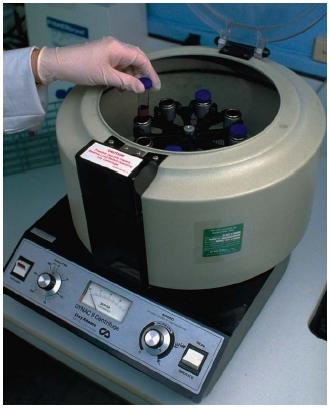
o   A centrifuge whirls a test tube around at high speeds forcing the denser materials to the bottom.
o   Works best for small volumes
                                                                        Centrifuge


·         Solvent Extraction
o   A technique also called liquid extraction, used to separate liquids.
o   Separation of a substance from a mixture by dissolving that substance in a suitable solvent
o   Works best with solvents that only dissolve one component
o   Mechanical mixture: (solid and solid) use liquid to dissolve one solid but not the other so the desired solid is left behind or dissolved.
o   Solution: solvent is insoluble with solvent already present. Solvent dissolves one or more substances and leaves unwanted substances behind.
·         Distillation
o   (liquid in liquid)
o   Based on differences in volatilities in a boiling liquid mixture
o   Physical separation process. Not chemical.
o   The liquid with the lowest boiling temperature boils first- vapour ascents to distillation flask and enters condenser; gas cools and condenses back to liquid dropping the distillate as a purified liquid.
                                                                  Process of Distillation


·         Chromatography
o   Can separate very complex mixtures
o   Accurate and very precise
o   Separated components can be collected individually
o   Flow the mixture over a material that retains some components more than others, so different components flow over the material at different speeds
o   A mobile phase sweeps the sample over a stationary phase
·         Sheet Chromatography
o   Paper Chromatography (PC)
§  Stationary phase= a liquid soaked into a sheet or strip of paper
§  Mobile phase = a liquid solvent
§  Components appear as separate spots spread out on the paper after drying or “developing”
Youtube Time!
  http://www.youtube.com/watch?v=fLc36wxLrVI


o   Thin layer Chromatography (TLC)
§  Stationary phase = a thin layer of absorbent coating a sheet of plastic or glass
§  Some components bond to the absorbent strongly; others weakly
§  As with paper chromatography components appear as spots on the sheet

By Candace

Thursday, October 14, 2010

Naming Acids

Acids are formed when a compound composed of Hydrogen ions and a negatively charged ion are dissolved in water. (aqueous)

  • ions seperate when they are dissolved in water
  • H+ ions joins with H2O to form H3O (hydronium ion)
Naming Guidelines

  1. Use "hydro" as the beginning
  2. The last syllable of the non-metal is dropped and replaced with "ic".
  3. Add "acid" at the end
*____ide --» hydro___ic acid


Complex Acids

  1. -ate is replaced with -ic                              *no hydro
  2. -ite is replaced with -ous
  3. "acid" at the end
An easy way to remember this:

"We ate ic-y sushi and got appendic ite ous."

Try some practice questions:
  1. NH4Cl
  2. Fe(NO3)3
  3. TiBr3
  4. Cu3P
  5. SnSe2
  6. GaAs
  7. Ph(SO4)2
  8. Be(HCO3)2
  9. Mn2(SO3)3
  10. Al(CN)3


  1. chromium (VI) phosphate
  2. vanadium (IV) carbonate
  3. tin (II) nitrite
  4. cobalt (III) oxide
  5. titanium (II) acetate
  6. vanadium (V) sulfide
  7. chromium (III) hydroxide
  8. lithium iodide
  9. lead (II) nitride
  10. silver bromide


 -Lauren

Friday, October 8, 2010

Naming + Writing forumlas for Ionic and Covalent Compounds

 Last class we reviewed material we first did in Grade 9 science. It's a fundamental part of Chemistry so make sure you know the stuff :)


Difference between Ionic and Compounds
* For covalent compounds, there is a special type called the Diatomic molecules. There are 7 of them (H2,O2,F2,Br2, N2, Cl2, I2). A way to remember them is by saying "I Bring Clay For Our New House".

Writing formulas for  Ionic Compounds
Basic → eg. Manganese (IV) Sulphide → Mn with a (+4) charge and Sulphur with a (-2) charge
- Simply switch the 2 subscript then you will have the answer
∴ Manganese (IV) Sulphide = Mn2S4 = MnS4
* You MUST simply the numbers if possible

Complex → eg. Ammonium Nitride =  (NH4)3N
- NH4 is Ammonium. You must put a bracket around it if there's another subscript followed behind.
 In other words, if there's no bracket, it will become NH43N. It's completely different and WRONG.

Naming Ionic Compounds
Basic →  eg. CaCl = Calcium Chloride
- Find the names from the periodic table that match with the symbols
* Remember the name of a compound always ends with "ide"
- Complex ions use the same method of naming. They just appear longer, doesn't necessary mean harder to name. eg. Cu2(NO3) = Copper (II) Nitrate

Ion with more than one charges eg. FeO = Iron (II) Oxide
- Iron can have charge (2+) or (3+)
- You must indicate which charge the ion has by using Roman numerals otherwise it may lead to confusion

Greek Prefixes (Please memorize them!)

* Be careful that #10 is "DECA"
   not "Deka" from the SI Prefixes


Naming Covalent Compounds
eg. CF4  → Carbon Tetraflouride   (Tetra = 4)
* If the first atom of the formula doesn't have a subscript, you don't need have to write "mono" for it. But if it's the second atom then you need it. eg. CO = Carbon Monoxide not Monocarbon Monoxide

Writing formulas for Covalent Compounds
eg. Diphosphorus Pentaoxide = P2O5   (Di = 2, Penta = 5)
- All you have to do is  match the prefix with the right number. Easy, isn't it? 


By Catherine 

Wednesday, October 6, 2010

Lab Experiment

For the class, we did Experiment 2B, "Heating and Cooling Curves of a Pure Substance". The experiment is to find out how long it takes pre substances to get to their melting point and freezing point. The pure substance we used during this class was dodecanoic acid.
The Cooling Process:
We first submerged the heated dodecanoic acid into the room temperature water. In 30 second intervals, we observed and recorded the temperature and solidity of the substance. We continued this for about 9 minutes until the temperature of the dodecanoic acid lowered to 25º C , whiten and solidify.
The Heating Process:
Now that we have cooled the dodecanoic acid, it is time to heat it up! We replaced the room temperature water with hot water that is around 60º C.  The beaker is placed on a hot plate to ensure the temperature does not drop. Next, the test tube is submerged into the hot water. The temperature of the dodecanoic acid rose steadily, slowly melting into a yellow liquid. The temperature of the dodecanoic acid reached around 59º C to turn into liquid completely.

Lastly, we made a graph out of the results.


-Victoria